Row Zero is a powerful spreadsheet that makes it easy to work with large healthcare datasets. We’ve created a free spreadsheet of ICD-10 codes to make it easy to look up 2026 ICD-10 codes for any diagnosis.
If you work with healthcare data in the United States, you’ve most likely crossed paths with ICD-10 codes. ICD-10 is the main coding system used to encode patient diagnoses in a variety of healthcare settings. Clinicians document ICD-10 codes in electronic health records, billers and coders use ICD-10 codes to communicate patient diagnoses with health insurance companies, and medical researchers and policy makers use ICD-10 codes to analyze claims data across large patient populations.
This guide explains what ICD-10 codes are, how they are used, and what you need to know to start working with ICD-10 codes. Continue reading to learn more about ICD-10 codes or open the spreadsheet to view the full list of 2026 ICD-10 codes.
ICD-10 Codes Dataset Summary
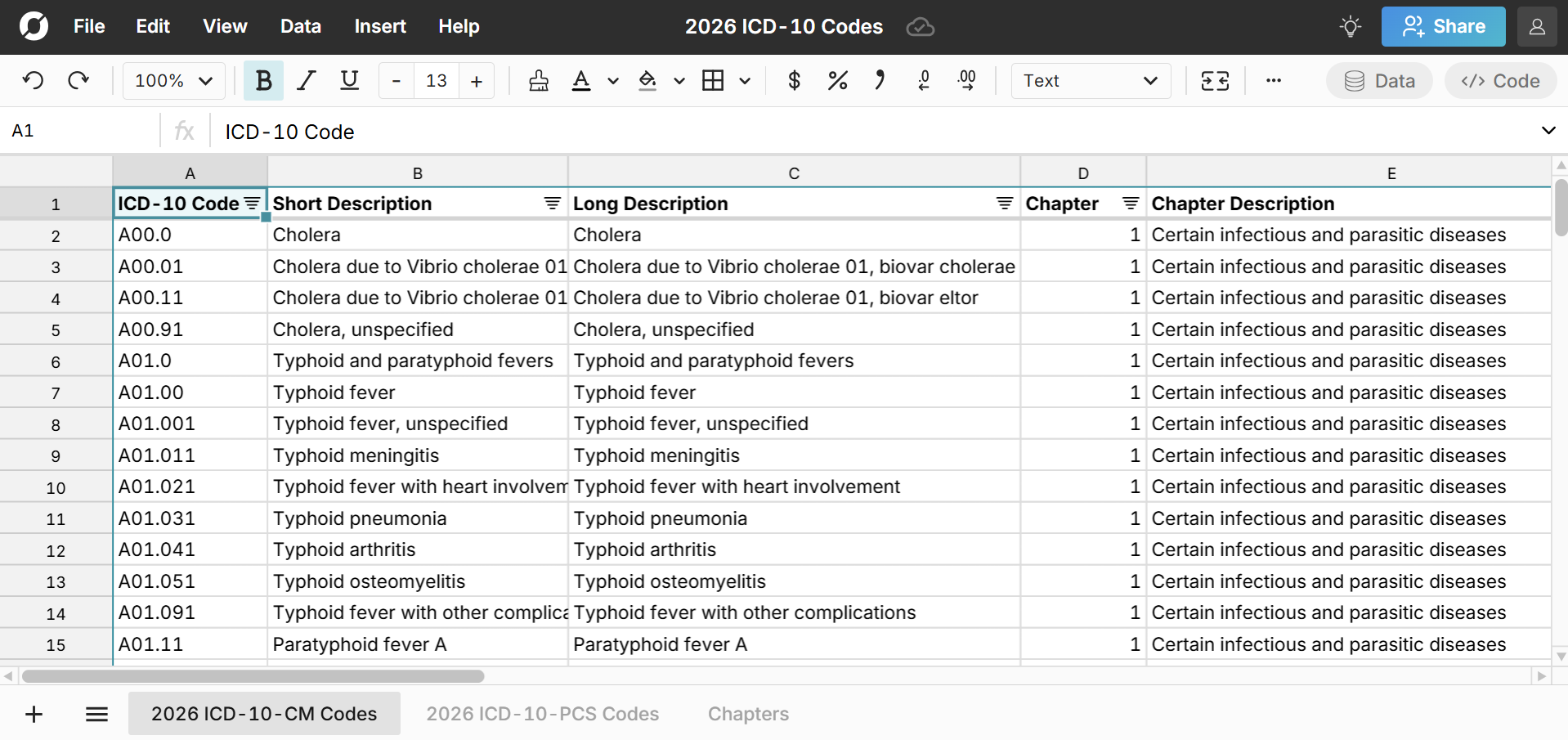
The dataset includes the full list of ICD-10 codes for 2026 published by the Center for Medicare & Medicaid Services (CMS) on CMS.gov, where you can download the raw files. CMS guidance is to “use these codes for discharges occurring from October 1, 2025 - September 30, 2026, and for patient encounters occurring from October 1, 2025 - September 30, 2026.”
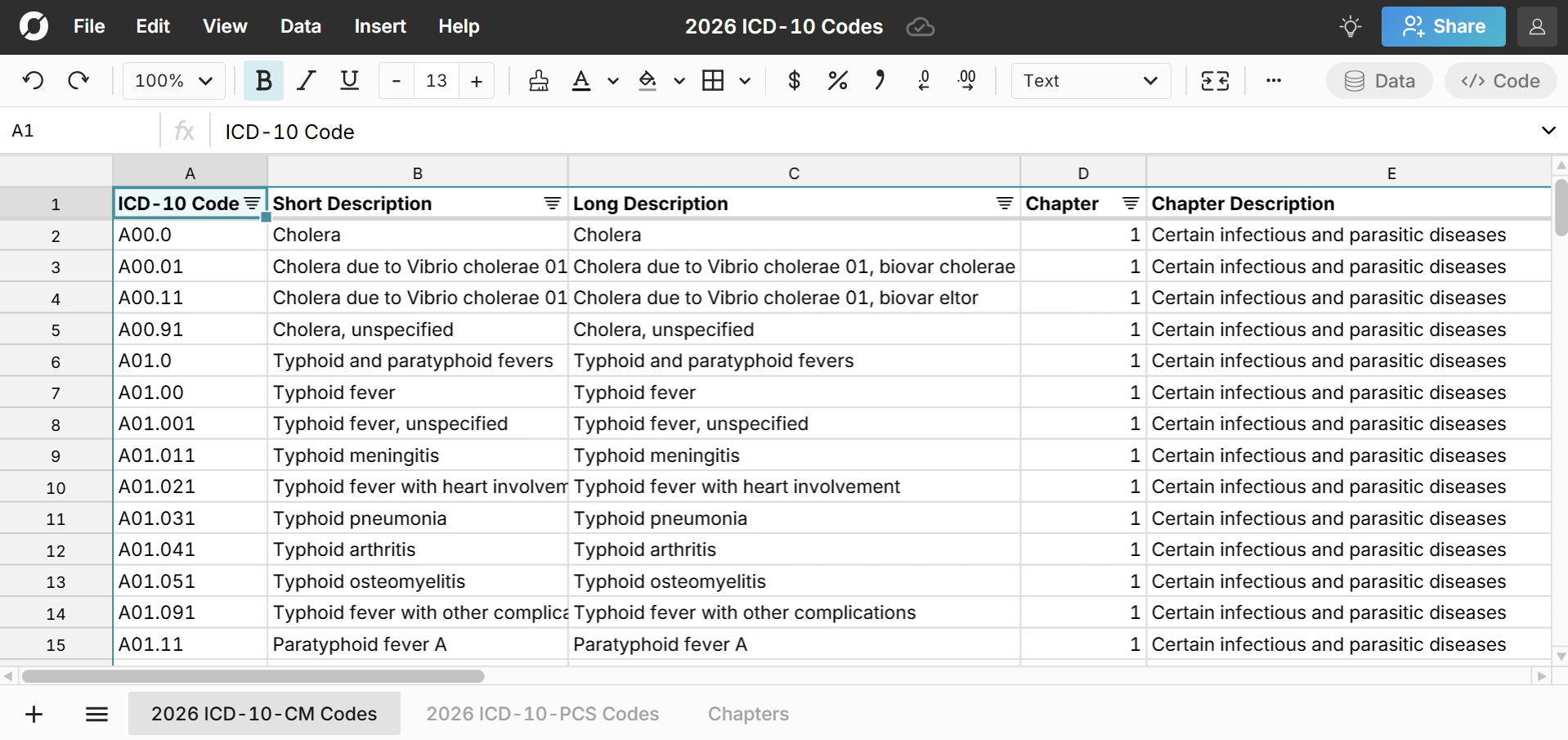
This ICD codes dataset includes the full list of ICD-10-CM codes and ICD-10-PCS codes, as well as a list of ICD 10 chapters. For each ICD-10 code, there is a short and long description, chapter, and chapter description.
What are ICD-10 codes?
ICD-10 is a medical diagnostic and procedure coding system commonly used in healthcare billing, claims, and medical research. The name “ICD-10” comes from the fact that the system is the 10th revision of the International Classification of Diseases published by the World Health Organization.
ICD-10 codes are essentially a standardized code to document a patient’s diagnosis. Standardizing patient diagnoses is helpful in a lot of different healthcare contexts: sharing a patient’s diagnosis across organizations (like a hospital to an insurance company), grouping patients by diagnosis, and analyzing patient trends (like measuring how many patients have a certain disease in an area).
List of all ICD-10 codes in a spreadsheet
CMS publishes ICD-10-CM codes annually on their website. However, these files take a bit of data wrangling to view in a spreadsheet. The files are made available as a series of compressed text files that need to be converted and imported into a spreadsheet.
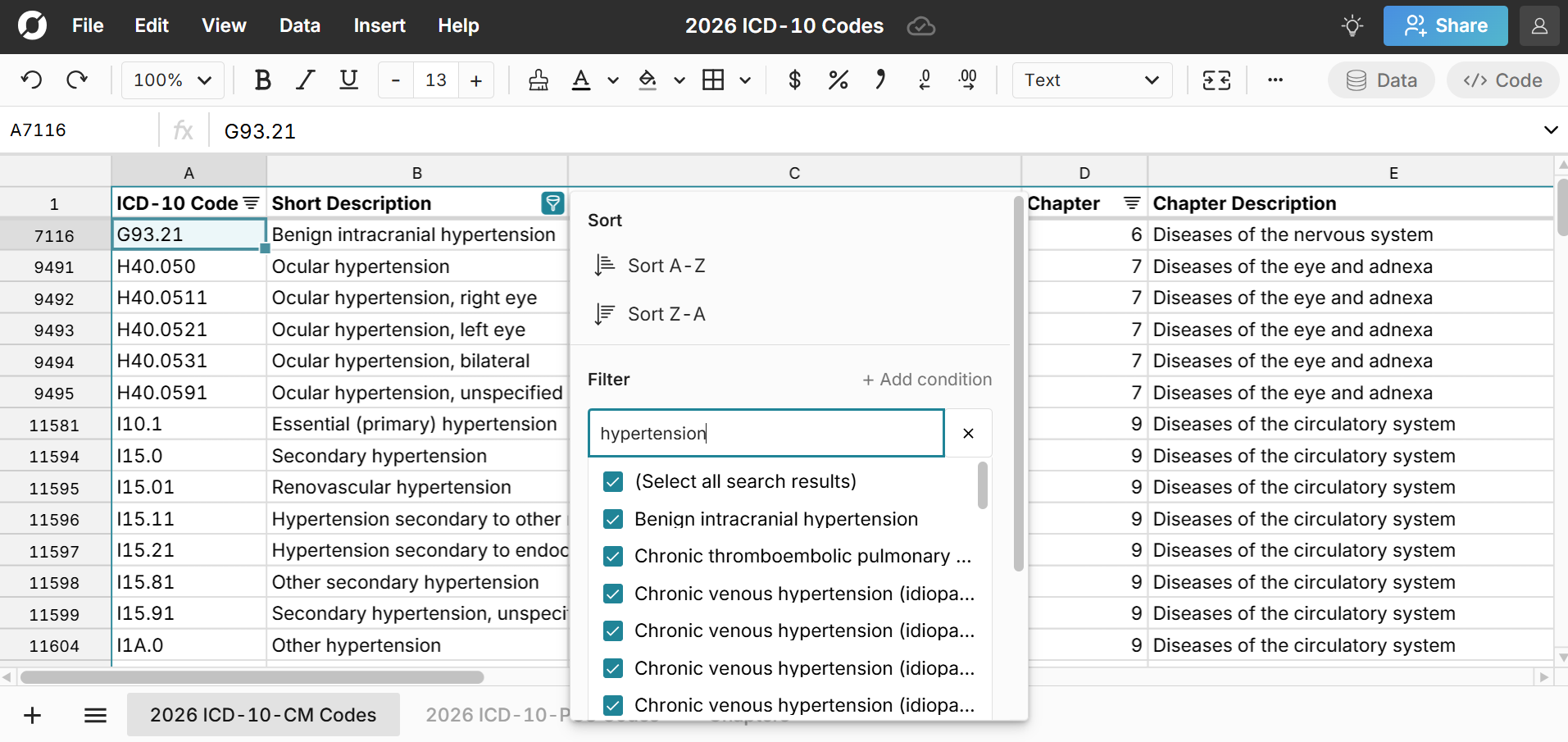
We’ve made the full list of 2026 ICD-10-CM codes and ICD-10-PCS codes available in this Row Zero spreadsheet. You can easily filter, sort, and search to look up ICD-10 codes by diagnosis or vice versa.
What are ICD-10 codes used for?
ICD-10 codes are used extensively in healthcare in the United States. ICD-10 codes are at the core of billing and reimbursement processes. Clinicians and health systems use ICD-10 codes to justify medical necessity for services to insurance companies, support procedure documentation (usually through CPT codes) on outpatient claims, and derive Diagnosis Related Group (DRG) coding for inpatient claims.
Because ICD-10 codes are the most common standard for encoding a patient diagnosis, they also play an important role in quality measures, population health, and medical research. A lot of healthcare software applications also use ICD-10 codes to drive clinical alerts and reminders.
What are ICD-10-CM and ICD-10-PCS codes?
While the World Health Organization publishes the base set of ICD-10 codes, many member countries produce their own modified and extended versions of the base ICD-10 codes. The United States produces ICD-10-CM (“Clinical Modification”) codes for diagnoses, as well as ICD-10-PCS (“Procedure Coding System”) codes for inpatient procedures.
For simplicity in this post, we'll just use “ICD-10” codes generically and unless otherwise noted, we’re talking about the ICD-10-CM diagnostic codes, which are more commonly used in practice than the ICD-10-PCS inpatient procedure codes. Both sets of medical codes are included in the spreadsheet.
Structure of an ICD-10 code
ICD-10 codes follow a standard structure. Each code is up to 7 characters long and codes are typically written with a decimal point after the 3rd character. The overall syntax of the codes follows a standard pattern:
- 1st character is a letter
- 2nd and 3rd characters are numbers
- Characters 4-7 are alphanumeric
The structure of the codes also have semantic meaning:
- The first character represents the “chapter” of disease, which broadly identifies what body system or type of condition the code belongs to. For instance, A and B are infectious and parasitic diseases.
- Characters 1-3 are the Category of the code, which is a broad category of the condition or disease. For instance, S52 is “Fracture of the forearm.”
- Characters 4-6 are the Etiology / Anatomical detail / Severity of the code. This may be something like a specific bone, the laterality of the break, or the specific part of the bone that is fractured.
- Character 7 is an extension, which gives information about the episode of care or healing status. Common 7th characters are A for initial encounter and D for subsequent encounter.
ICD Code Chapters
There are 22 ICD Code chapters representing different types of conditions or body systems and each ICD code is assigned to a chapter. The ICD Chapters sheet includes a count of ICD codes by chapter.
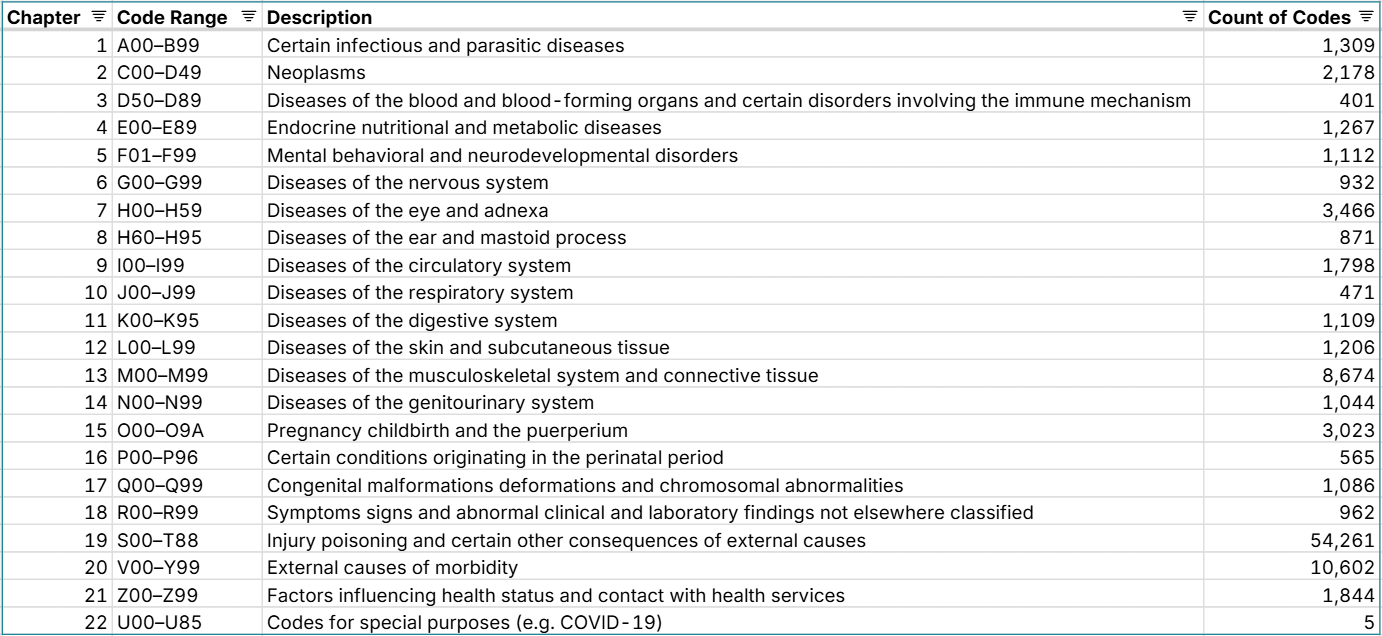
As you can see Chapter 19 (Injury, poisoning and certain other consequences of external causes) has the most ICD codes by far.
Why are ICD-10 codes so specific?
ICD-10 codes are meant to codify nearly every diagnosis that a patient could present with. This means that each code must be very specific. The U.S. transitioned from ICD-9 to ICD-10 in October of 2013. The transition increased the number of codes from about 14,000 to about 69,000 and the number of ICD-10 codes has increased steadily ever since with the 2026 ICD-10-CM list topping 98,000 codes. CMS believes that increasing the number of codes leads to more accurate data collection, clearer documentation of diagnoses and procedures, and more accurate claims processing.
Since ICD-10 codes attempt to codify every possible diagnosis, there are some comically specific codes like V91.07XD: Burn due to water-skis on fire, subsequent encounter, W61.62XD: Struck by duck, subsequent encounter, and V97.33XD: Sucked into jet engine, subsequent encounter. There is even a book with funny illustrations of some of the more absurd codes.
Difference between ICD-10 codes and CPT codes
Insurance companies generally use ICD-10 codes for clinicians to specify a patient’s diagnosis and a CPT code to specify the intervention that was taken for the patient, like a procedure, lab test, medication, imaging test, etc. While the ICD-10-PCS codes are meant to capture procedures similar to CPT codes, they only cover Inpatient procedures, whereas CPT codes cover most all billable services in any clinical setting.
ICD-10 codes are published and freely available from CMS. CPT codes are published by the American Medical Association (AMA) and are proprietary. Using or publishing CPT codes requires licensing from AMA.
Use Cases for this Dataset
Row Zero is a powerful HIPAA compliant spreadsheet application that makes it easy to work with large healthcare datasets. You can easily import your data into the ICD code lookup spreadsheet (or vice versa) for several use cases:
- Lookup ICD codes by diagnosis or identify a diagnosis by its ICD code. You can use the find, filter, and sort features to drill down to specific diagnoses or view lists of ICD codes by chapter.
- Map health data across different datasets using XLOOKUP to join medical datasets using ICD codes.
- Import ICD codes to your database or data warehouse. Row Zero has built-in connectors to Snowflake, Databricks, Redshift, Postgres, BigQuery, Oracle, and more, so you can easily standardize medical billing, claims, and research in your data warehouse.
Frequently Asked Questions
ICD codes are the main coding system for patient diagnoses in electronic health records and for medical billing and coding.
ICD stands for International Classification of Diseases and is published by the World Health Organization.
There are 98,186 ICD-10-CM codes in the 2026 ICD-10 codes list published by the Center for Medicare & Medicaid Services.
Yes, the ICD spreadsheet provided here is free, as are the source datasets provided by CMS.gov.