
We just wrapped Snowflake Summit 2026 in San Francisco, and I want to share what we saw and heard while it is all still fresh. This year felt different from past years. The conversations at our booth were sharper. The interest was more urgent. And the themes emerging across the conference tell a clear story about where enterprise data is heading.
Here is my honest take on everything, from the big Snowflake announcements to what we learned about the data security problem that most organizations still have not solved.
What Row Zero launched
For the first time at this event, we were demonstrating workspaces and admin screens, which gave enterprise buyers a real picture of how Row Zero fits into their existing data governance and access control models. These are not checkbox features. They are the difference between a tool a data team adopts informally and one an IT organization can actually sanction and deploy.
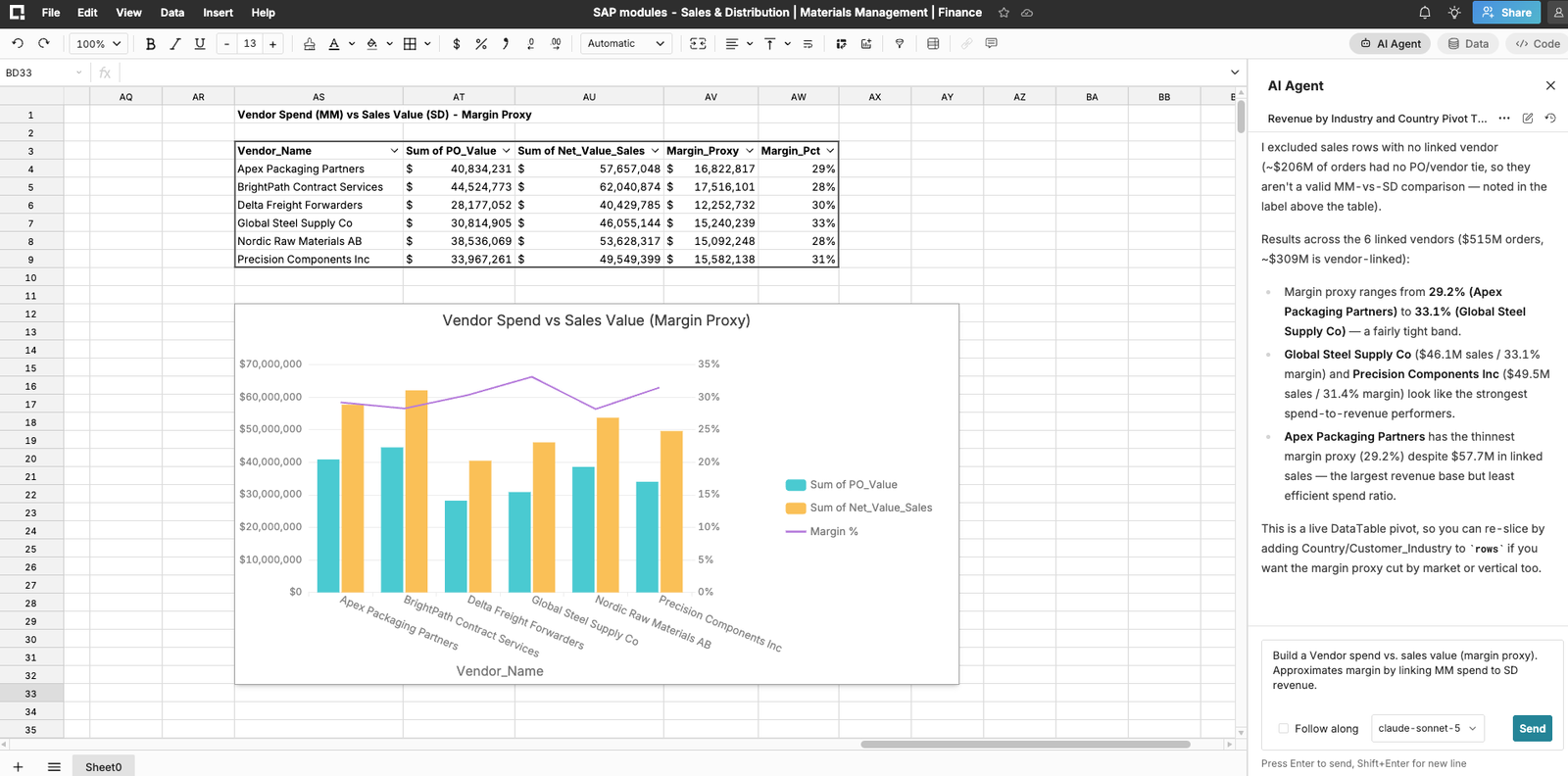
Pivot 2.0 drew consistent reactions in demos. Pivoting 30 million rows in real time, right inside the spreadsheet interface, is still something that surprises people who have been conditioned to expect that scale means waiting. It does not have to.
Our new Oracle and SQL Server connectors broadened the conversation significantly. Many enterprise organizations do not run purely on Snowflake. They have legacy systems running alongside their modern data stack, and the ability to connect Row Zero to both without exporting anything is a meaningful unlock.
AI integration was a major talking point. We are inside Snowflake Cortex, and the demos showed how business users can ask questions in plain language and get answers without writing a line of SQL. One of our existing customers told us their consultants have been using the AI agent to build entire spreadsheet models. That is the kind of use case that travels.
Query Builder may have been the single most impactful demo of the conference. The question we used to hear constantly at the booth was, "What if my users do not know SQL?" We did not hear that question once this year. Query Builder answers it before anyone has to ask. Business users watched it work and immediately understood what it meant for their teams.
Cross-workbook references, Private Link support, and the Slides integration rounded out the demo story. Olaplex stopped by multiple times specifically because they are excited about automated reporting and the Slides integration. They described a future where a chart in a presentation automatically includes a prose explanation of what drove the change. That is where AI in the spreadsheet is heading, and we are building toward it.
“The product is so much better than last year. It was our first Snowflake Summit with workspaces, admin screens, Pivot 2.0, Oracle and SQL Server connectors, AI, cross-workbook references, and Private Link. Query Builder was hugely impactful.”
Write-back came up in more conversations than any other feature request. The ability to push data from a spreadsheet back into Snowflake matters enormously to finance teams running planning cycles, to ops teams managing forecasts, and to any team trying to close the loop between analysis and action. We make it simple to get data into Snowflake with our write-back feature.
The big Snowflake announcements
Snowflake came to the conference ready to make a statement. Their announcements this year were focused on one clear theme: making it easier to build, ship, and scale faster inside the Snowflake ecosystem. Here is what they unveiled.
❄️ Snowflake CoWork A personal work agent designed to help individuals work smarter. CoWork, formerly known as Snowflake Intelligence, is Snowflake's bet on the intelligent work layer sitting above the data warehouse. For Row Zero, this creates an interesting integration opportunity. An MCP connector to CoWork could let customers like Huron and RLI combine the analytical power of Row Zero with the agentic capabilities of CoWork, and we are actively thinking about what that looks like.
❄️ Snowflake CoCo (Cortex Code) The coding agent where developers build faster. CoCo is Snowflake's answer to the AI-assisted development question, and it includes a native desktop app that brings Snowflake development to Windows and macOS. Snowflake hosted multiple sessions on building Cortex agents and semantic views, and the message was clear: they are building toward a world where the data warehouse is the foundation for every agent in the enterprise
❄️ CoCo Desktop A native desktop app that brings Snowflake-native development to Windows and macOS. Paired with the broader Cortex Code environment, this signals Snowflake's intent to compete for developer time outside the browser.
❄️ Datastream A native, Apache Kafka-compatible streaming service that eliminates the need for separate streaming infrastructure. Datastream brings real-time data and AI together in a single governed platform, which removes a significant architectural complexity for data engineering teams managing event-driven pipelines.
❄️ Horizon Context The context layer for AI and business intelligence. Horizon Context ensures that every person, tool, and agent in the organization operates from the same trusted business definitions. This is Snowflake's answer to the semantic layer question, and it matters because AI is only as trustworthy as the definitions it operates from.
❄️ Cortex Sense A shared context layer that automatically brings together the business definitions and operational knowledge AI agents need to be trustworthy and useful. Cortex Sense extends Snowflake's semantic foundation into the agentic world, giving AI agents access to governed, authoritative context instead of guessing.
The throughline across all of these announcements is that Snowflake is clearly trying to become more than a data warehouse. They are building a platform where data, AI, and agents all live together in a governed environment. That ambition aligns well with where Row Zero sits. We are the spreadsheet layer in that stack, giving business users a familiar, powerful interface that sits on top of Snowflake without moving data out of it.
The positioning shift happening across the industry
If you walked the conference floor this year with fresh eyes, the dominant experience was noise. Every booth was talking about agents. Every keynote referenced AI. The phrase "Agentic AI" and "Agentic Enterprise" appeared so frequently and in so many different contexts that it stopped meaning anything. Vendors were stacking buzzwords in ways that did not connect to real problems or real solutions. The visual design was busy. The messaging was abstract.
Sigma had one of the biggest physical presences at the show. Multiple booths, branding on staircases, ice cream sandwiches, TVs throughout the venue. Their messaging has evolved and now focuses primarily on data apps and agents. It is an ambitious position, but it created an interesting dynamic in our conversations. When prospects compared Sigma to Row Zero, many of them said something like, "Do we need spreadsheet-like interface? Or do we just need a spreadsheet?"
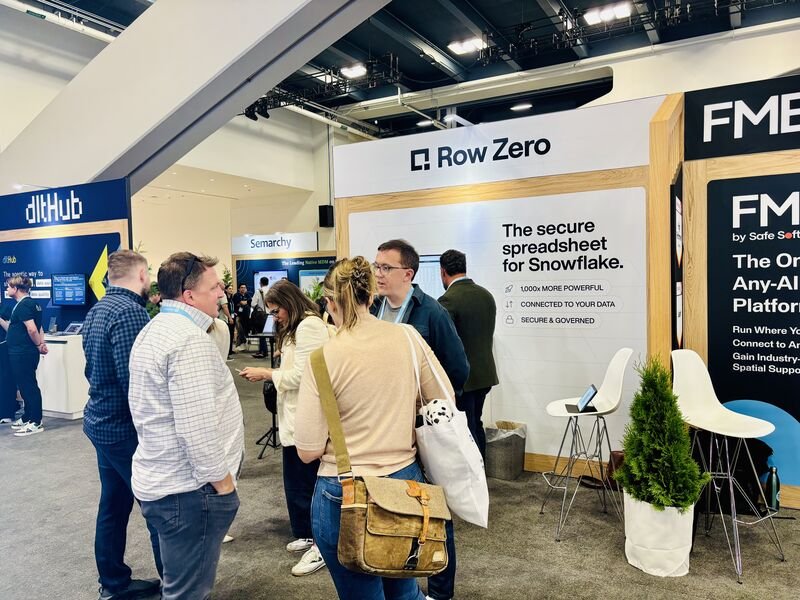
Our positioning at the Row Zero booth was simple, direct, and intentionally so. We did not try to out-agent anyone. The secure spreadsheet for Snowflake, handles billions of rows, and keeps your data governed and secure. Business users get the power of the warehouse without depending on engineering.
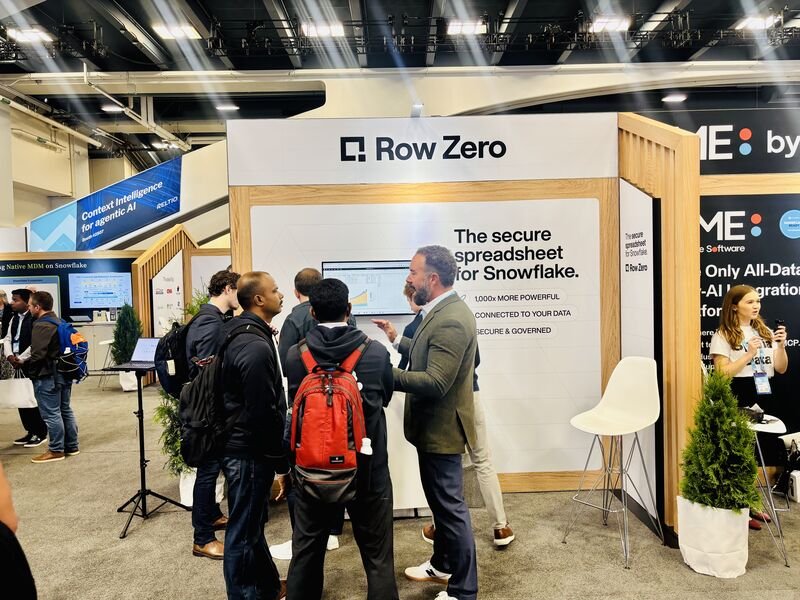
That clarity worked. Attendees visibly relaxed when they heard it. In a hall full of products solving problems they did not fully understand, a product with a clear purpose and a clear audience is a relief. The demos closed conversations that the pitch started, and the pitch was short enough that we could get to the demo fast.
The lesson I keep coming back to: simplicity is not a constraint. It is a competitive advantage. When everyone else is explaining what they mean by "agentic," you can just show someone 30 million rows loading in seconds. The demo does the work.
Data governance and security: the problem most teams have not solved
This was the most substantive theme that emerged from our booth conversations, and it deserves its own section.
Here is the reality in most enterprise Snowflake environments right now. Organizations have done significant work to build clean, governed data inside the warehouse. They have invested in access controls, audit logs, and data catalogs. Then a business user opens Tableau, Power BI, or Sigma, runs a query, and clicks "Export to CSV." That CSV lands on a laptop, gets emailed to three people, gets attached to a presentation, and gets forwarded to a vendor. The governance story is over at that point. All of the investment in Snowflake security is downstream of that export button.
We heard this pattern described in conversation after conversation. What surprised me was not that the problem exists. It is that the organizations who have experienced a breach or a data incident on exactly this vector came to us inbound, actively looking for a solution. They had lived through the consequence of data sprawl and they wanted to eliminate the root cause, not manage the symptoms.
Those conversations had a different energy than a standard product evaluation. They were not asking whether the problem was real. They knew it was real. They were asking how quickly we could solve it.
Not everyone wants to ban CSV downloads, but for those who do, Row Zero has a really strong value prop. It takes people a while to make the leap from 'I want to ban CSV downloads' to 'I need a cloud spreadsheet called Row Zero.'
The problem most enterprises face is not that they do not care about data security. Most security and data governance leaders care deeply. The issue is that they feel stuck. Telling users they cannot export to CSV anymore means telling analysts, finance teams, and operations leaders that their workflow is broken, with no clear alternative. That is a hard conversation to start, and so most organizations do not start it.
Row Zero changes the calculus. The shift we propose is not "remove CSV exports" as a standalone policy. It replaces the workflow entirely. Instead of exporting to CSV, users open their data directly in Row Zero. The interface is familiar. It looks and works like a powerful spreadsheet. The data stays in Snowflake. The export button disappears because it is no longer needed.
"Export to CSV" becomes "Open in Row Zero." That is a workflow improvement, not a restriction. Business users get something better. Security and governance teams get the control they have been trying to implement. And the data never leaves the governed environment.
Enterprises that have not yet experienced a breach on this vector tend to know the risk exists but feel like eliminating CSV exports requires too much organizational friction to be worth starting. The organizations that have been through an incident do not feel that way anymore. They want to move fast. Row Zero is the fastest path from "we have a data sprawl problem" to "the problem is solved."
We should be having this conversation with every enterprise data security leader in the Snowflake ecosystem. The technology is ready. The architecture is clean. The ROI is obvious to anyone who has calculated the cost of a data breach versus the cost of a better spreadsheet tool.
What we are taking forward
Snowflake Summit 2026 was the best conference we have had as a company. The product story is stronger, the positioning is clearer, and the market is more ready than it has ever been.
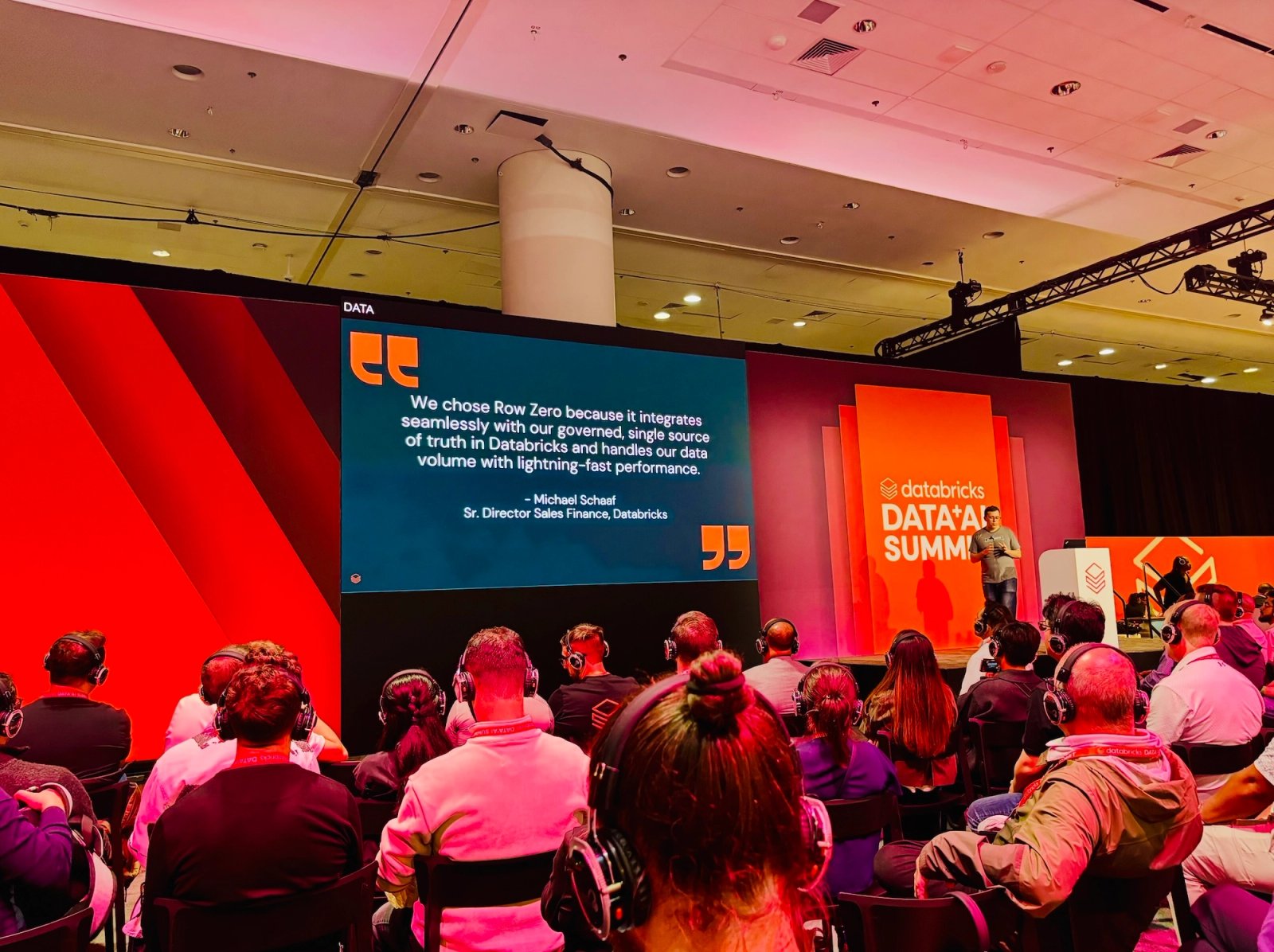
If you want to see the demo we showed at the Snowflake Summit, or if any of the themes in this post resonate with something your team is working through, we would love to talk. Click here to schedule a demo. See you next week at the Databricks Data + AI Summit!