Agentic analytics shifts data from passive dashboards to active AI agents that ask questions, investigate data, and deliver verifiable findings. While every major data platform is racing to build these AI agents, most overlook where the agent actually works and how humans can trust the results. Row Zero closes this gap by providing the transparent environment needed to audit and trust AI-driven insights.
What Agentic Analytics Actually Means
Agentic analytics uses autonomous AI agents to explore data, generate insights, and take context aware action with minimal human intervention. Instead of an analyst manually building a query or refreshing a dashboard, an agent continuously monitors data, reasons about what it finds, and either surfaces an insight or triggers a next step on its own.
This marks a major shift in how analytics gets done. Traditional business intelligence is entirely reactive, relying on a human to ask a question before a dashboard or report can answer it. In contrast, agentic analytics is entirely proactive. The system runs continuously, constantly searching for critical insights and autonomously taking action without needing a human prompt.
The Agentic Loop
Most agentic analytics systems follow a version of the same closed loop:
- Ingest: pull data from warehouses, databases, APIs, and event streams
- Analyze: detect trends, anomalies, or performance changes
- Explain: translate the finding into plain language a business user can understand
- Recommend: propose a next step grounded in that finding
- Act: trigger a workflow, alert, or update when conditions are met
Each pass through the loop is supposed to make the next one smarter, as agents learn from which recommendations were accurate and which were not.
Agentic Analytics vs. Traditional BI
The table below captures the practical differences between the two approaches.
| Traditional BI | Agentic Analytics | |
|---|---|---|
| Approach | Reactive, query driven | Proactive, AI driven |
| Insight generation | Static dashboards and reports | Continuous, automated insight generation |
| User interaction | SQL or dashboard setup required | Natural language, conversational |
| Time to insight | Hours or days, tied to reporting cycles | Near real time |
| Decision support | Humans interpret and act | Agents recommend or trigger actions |
| Scalability | Limited by analyst headcount | Scales across large datasets and workflows |
The Blind Spot Most Agentic Analytics Platforms Share
Every framework for agentic analytics, including the one data platforms themselves publish, calls out the same requirements: clean governed data, an orchestration layer, a reasoning layer, and strong governance with a human in the loop for high impact decisions. What almost none of them address directly is a much more basic question. Once the agent has reasoned its way to an answer, where does that reasoning actually live, and can a person check it?
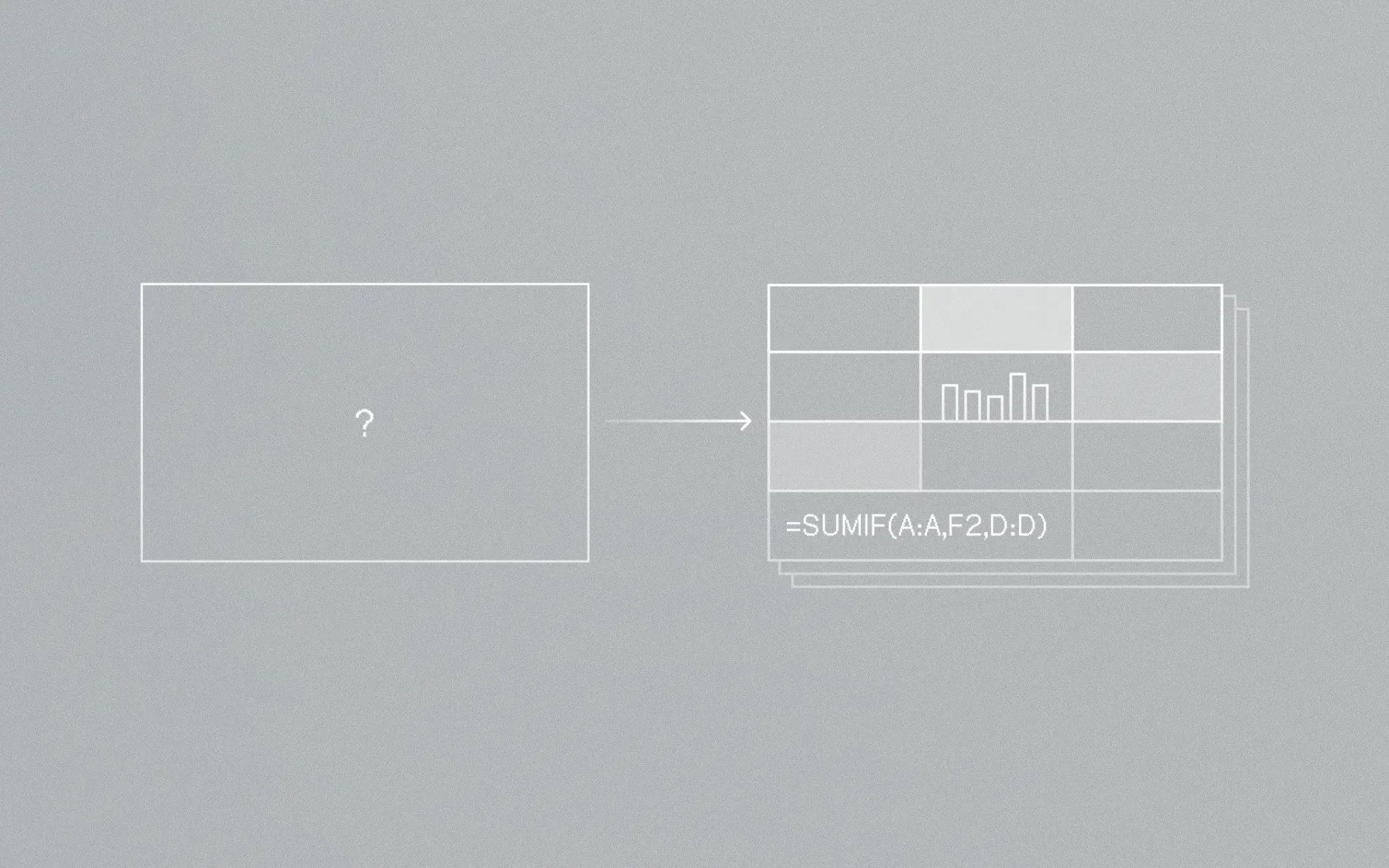
A chat style answer from an AI agent is a conclusion, not a workspace. If a finance leader gets a number back from a conversational interface, the only way to validate it is to trust the agent or ask someone to rebuild the analysis from scratch. That is a hard sell in any regulated or audit sensitive environment, and it is exactly the objection Row Zero hears most often from enterprise data and finance teams evaluating AI tools.
This is the real constraint on agentic analytics adoption inside the enterprise. It is not whether the agent can find the insight. Modern models are already good at that. It is whether the business can trust, trace, and act on what the agent found.
Where Row Zero Fits in the Agentic Analytics Market
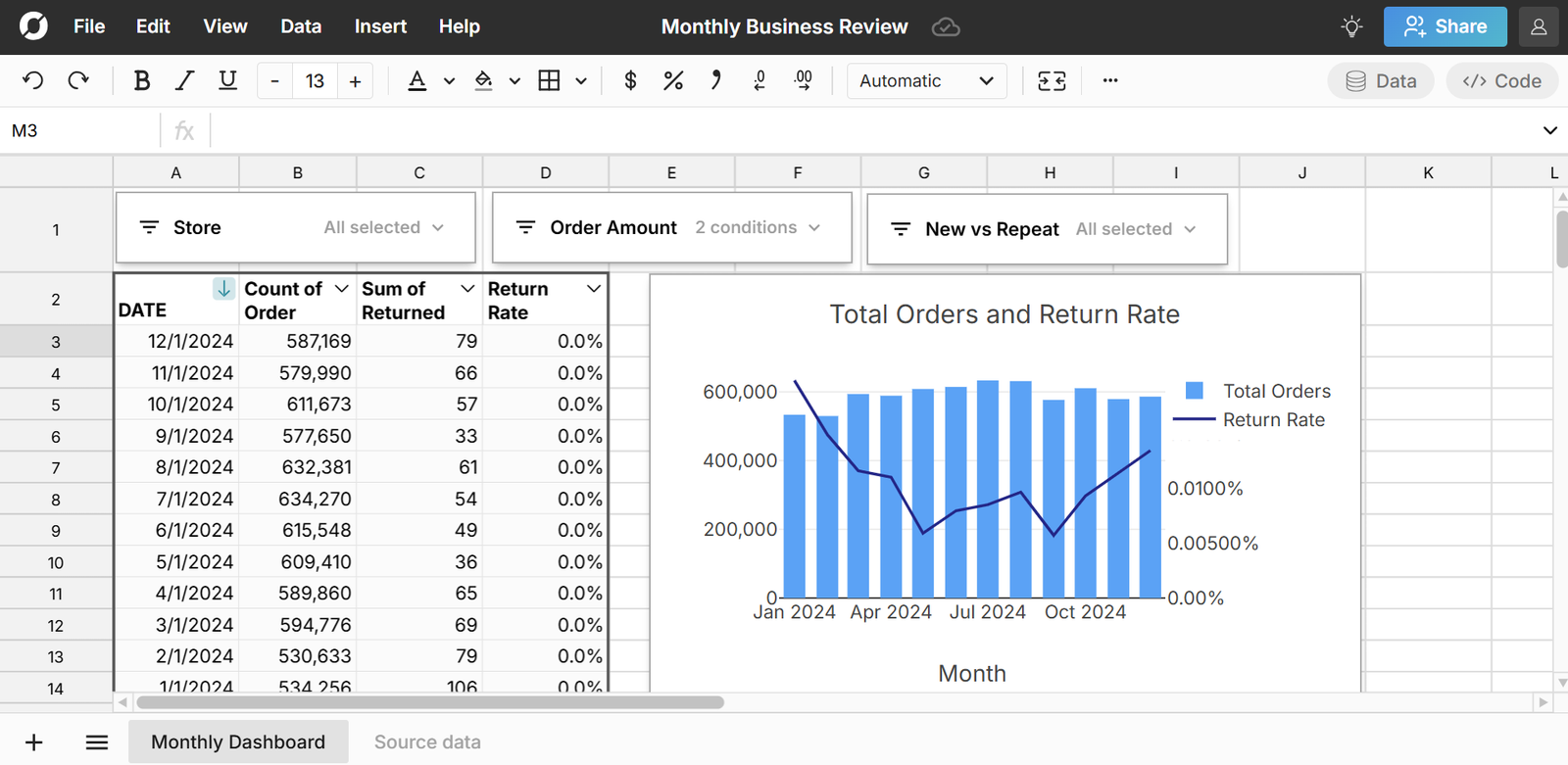
Most vendors are building the reasoning layer, the orchestration layer, or the semantic layer that agentic analytics depends on. Row Zero is cloud native spreadsheet that is the workspace layer where an agent's analysis becomes a transparent, editable artifact instead of a black box answer.
Row Zero connects live to all of the major data warehouses including Snowflake, Databricks, Redshift, and BigQuery, and performs at cloud scale on datasets with billions of rows. That matters for agentic analytics because a spreadsheet is the one interface where an AI agent's formulas, calculations, and intermediate steps are visible line by line, in a format every business user already knows how to read.
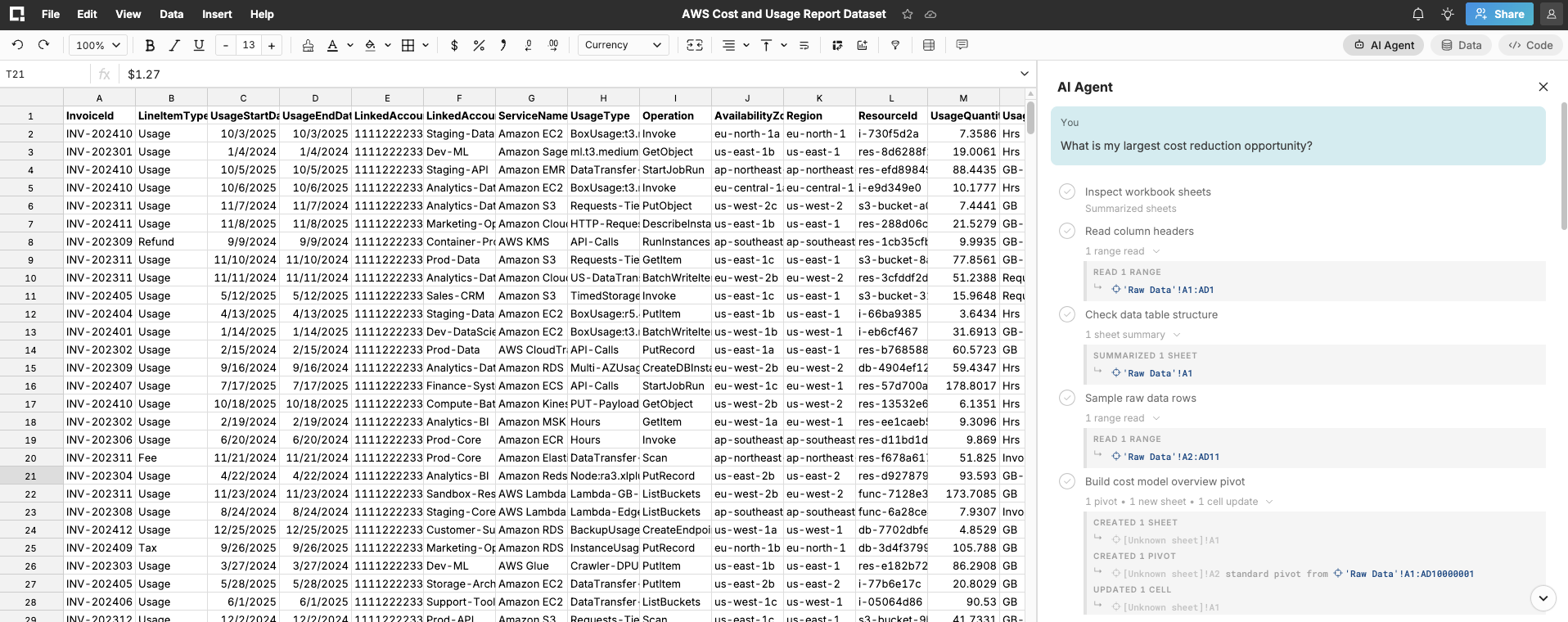
When Row Zero's AI agent answers a question, it does not just return a number in a chat window. It builds the analysis directly in the workbook, using formulas and connected data a person can click into, trace, and correct. If a number looks wrong, a user drills into the calculation rather than trying to reconstruct how a conversational answer was produced. That single design choice is what turns an AI agent's output from a claim into a verifiable artifact.
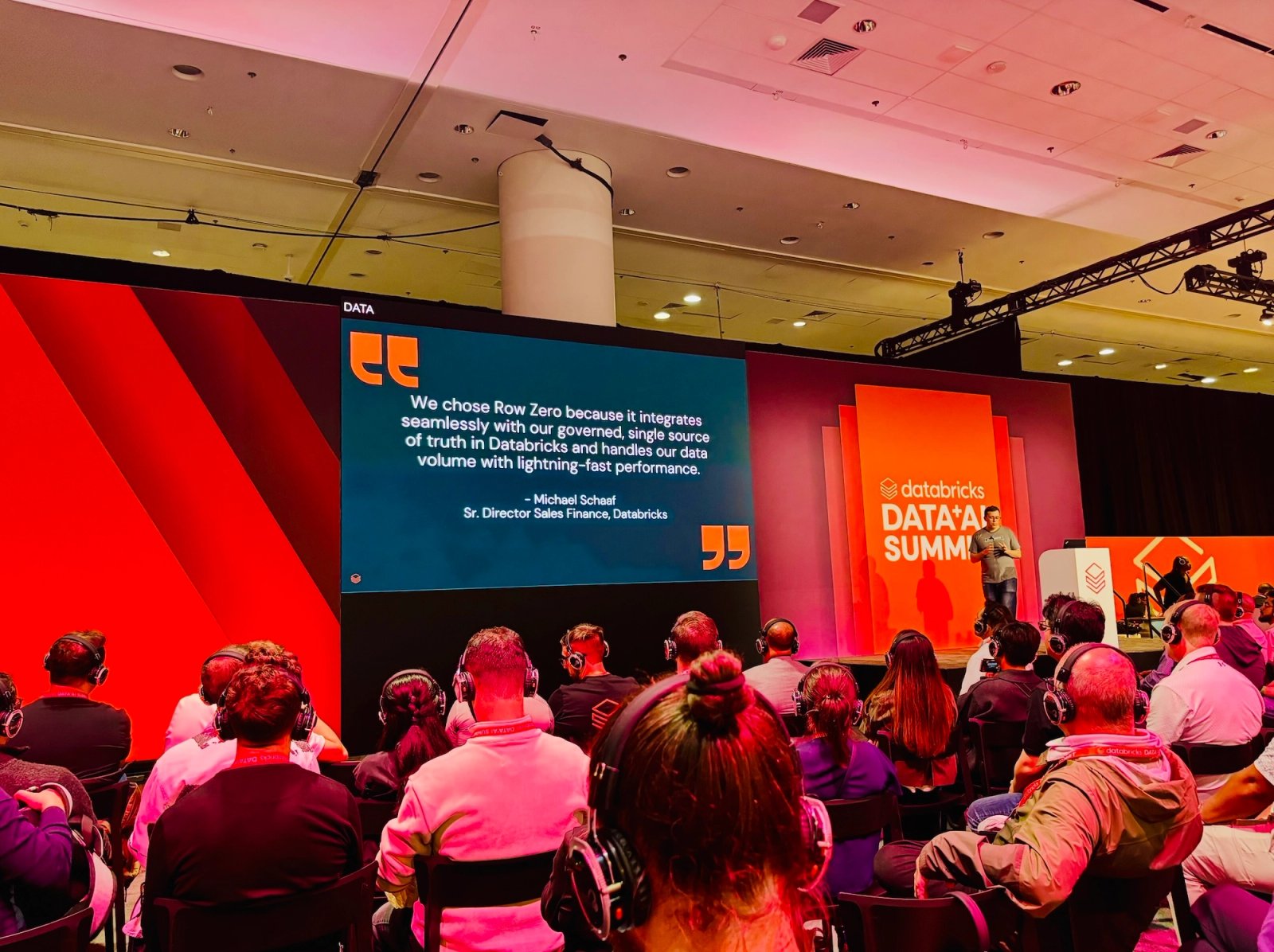
This is how enterprise teams are using Row Zero today. Databricks' own FP&A team runs financial analysis in Row Zero rather than exporting data out of the warehouse into legacy spreadsheets. AWS evaluated thirteen alternatives, including building an internal tool and adopting BI platforms with spreadsheet-like interfaces, before selecting Row Zero specifically because their teams wanted an intuitive spreadsheet that worked at cloud scale while meeting AWS security requirements.
Why Row Zero Beats Traditional BI Tools for Agentic Analytics
Traditional BI dashboards and standalone AI chat tools each solve half of the agentic analytics problem. Dashboards are governed and auditable but static, built to answer the questions someone anticipated in advance. Chat based AI tools are fast and conversational but disconnected from the governed data layer, and their reasoning disappears the moment the answer is given. Row Zero is built to be the layer that does both at once.
| Traditional BI Dashboards | Standalone AI Chat Tools | Row Zero | |
|---|---|---|---|
| Handles unanticipated questions | No, limited to pre-built views | Yes, but ungoverned | Yes, live and governed |
| Auditable, step-by-step output | Yes, but static | No, black box reasoning | Yes, formula-level trace |
| Scales to billion-row datasets | Varies by platform | No, context window limited | Yes, natively |
| Live connection to the warehouse | Yes, but read-only reporting | Rarely direct | Yes, two-way connected |
| Editable, shareable by business users | No, requires BI team | No, single-turn answer | Yes, familiar spreadsheet UI |
| Data leaves the warehouse | Sometimes, via exports | Often, via uploads | Never, Zero Data Retention |
The practical result is that Row Zero lets analytics and finance teams get the speed and reach of an AI agent without giving up the audit trail that BI teams and security leaders require. The agent works inside the same governed, connected environment the rest of the business already trusts.
A Familiar Example
Consider a regional finance team that notices margin compression in one product line. Instead of filing a request with the data team and waiting days for a new report, an analyst opens a Row Zero workbook already connected to the warehouse and asks the AI agent to investigate. The agent segments the data by product, region, and channel, isolates the accounts driving the change, and builds the supporting calculations directly in the sheet.
Because the output is a live workbook and not a chat transcript, the finance leader reviewing the result can open any cell, see exactly how the number was derived, and extend the analysis with a new pivot without starting over. That is the difference between an agent that produces an answer and an agent that produces work a business can stand behind.
What to Look for in an Agentic Analytics Solution
Based on how enterprise teams are actually evaluating and adopting this technology, a few capabilities separate platforms that work in production from ones that stay stuck in pilot:
- Direct, governed connections to the data warehouses the business already relies on, without requiring exports
- Performance at the scale of the real dataset, not a sampled version
- A transparent workspace where agent reasoning can be audited and corrected
- Enterprise-grade security, including row level security and RBAC
- An interface business users already know how to work in, so adoption does not depend on retraining an entire team
Row Zero was built around these five requirements from the start, which is why it shows up as the workspace of choice for teams at AWS and Databricks, who are already putting agentic analytics into production.
The Bottom Line
Agentic analytics shifts the core work of data analysis from humans to autonomous AI agents rather than just speeding up static dashboard creation. For this shift to succeed at an enterprise level, business teams must be able to trust, audit, and expand upon the agent's work. A secure, cloud-native spreadsheet solves this challenge by connecting directly to live data warehouses and processing billions of rows. It acts as a familiar, transparent environment where users can verify the AI’s formulas and logic line by line.